Wolf Spiders: Harmless, Webless and Passing Through
Wolf spiders are harmless to people, build no web, and do not form an indoor population. The ones found in houses are wanderers that came in at ground level in late summer or autumn looking for somewhere to overwinter. A female carries her egg sac attached to her spinnerets and then carries the spiderlings on her back for about two weeks, which is behaviour no other common household spider shows.
Wolf spiders generate more alarm than any other spider people actually find, because they are large, fast, hairy and encountered on the floor rather than in a web. Almost all of that alarm is misdirected. The useful questions are whether it is a wolf spider at all, and why it is inside.
How to be sure it is a wolf spider
| Feature | Wolf spider | What it rules out |
|---|---|---|
| Eyes | Eight, in three rows of four, two and two, with two very large middle eyes | A brown recluse has six, in three separated pairs |
| Web | None. It hunts on foot | House and cellar spiders sit in a web |
| Eyeshine | Reflects a torch beam back at you at night | Few other house spiders do this |
| Body length | Commonly a quarter of an inch to over an inch; Carolina wolf spider females reach 22 to 35 mm | A recluse is 7 to 12 mm |
| Legs | Stout, often banded or mottled, visibly spined | A recluse has uniformly pale legs with no spines and no bands |
| Egg sac | Carried attached to the spinnerets, then spiderlings ride the abdomen | Nothing else common does this |
The eyeshine test is the quickest one available to a homeowner. Take a torch outside after dark, hold it at eye level and sweep the lawn: wolf spider eyes return green points of light from surprisingly far away. It is also the fastest way to discover how many are already living around a house without ever coming inside.
The size point is worth stressing because the fear is almost always recluse-shaped. A wolf spider is several times the bulk of a brown recluse. If it is big enough to be startling across a room, it is not a recluse. Our guide to identifying spiders by the evidence covers the recluse question in full, including why the violin marking is unreliable.
Are they dangerous?
No. The Missouri Department of Conservation states plainly that the bites of North American wolf spiders are harmless, and Penn State Extension reports that symptoms from a bite subside within 24 hours with no serious medical consequences. They are not aggressive and they bite only when handled or trapped against skin.
Like nearly all spiders they do have venom, which they use on insects. That is a different statement from being dangerous to a person, and the distinction gets lost constantly in spider coverage.
The genuine risk in a wolf spider encounter is the reaction to it, not the spider: people fall off chairs, spray aerosol insecticide at floor level near children and pets, or fog a whole house over a single animal that would have left on its own.
Why one is in your house
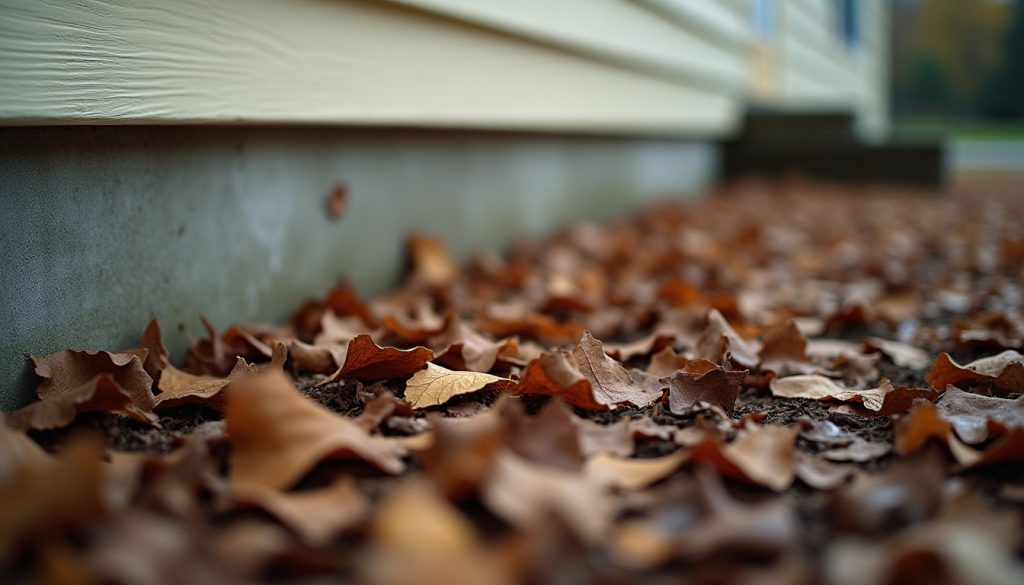
Wolf spiders hunt at ground level in grass, leaf litter, mulch and under stones. They come indoors the same way ground beetles and crickets do, through gaps at the base of the building, and they do it most in autumn when they are looking for somewhere to overwinter.
This is the single most useful thing to know about them, because it dictates the response. There is no nest to find and no population to eliminate. A wolf spider indoors is a spider that took a wrong turn at a door sweep.
It also explains why spraying the inside of a house is close to pointless for this species. The insect is not breeding in there, is not feeding on a resource in there, and the next one will walk in through the same gap a week later. Exclusion at grade level is the treatment, which is the same logic set out in our guide to pest-proofing a property.
What to do about them
- For a single spider, a cup and a card. Release it outside, away from the foundation.
- Close the ground-level gaps. Door sweeps, thresholds, garage door seals, gaps around utility penetrations and basement window frames are where they get in.
- Reduce the harbourage against the wall. Deep mulch, leaf litter, stacked wood and stone against the foundation put a hunting population right at the entry points.
- Cut the insect supply. Exterior lighting draws the insects wolf spiders hunt. Moving lights away from doorways or switching to warmer colour temperatures reduces the attraction.
- Do not fog or broadcast spray indoors for wandering spiders. It exposes the household to a product for no durable benefit, since the source is outside.
- If sightings are frequent, treat it as an exclusion survey, not a spider problem. Repeated wandering spiders indicate an open building envelope, which will also be admitting other pests.
Where a professional is warranted, the work is an exterior perimeter and exclusion job rather than an indoor treatment; our spider control pricing covers what that involves.
The mother carrying her young
Female wolf spiders attach the egg sac to their spinnerets and drag it with them while hunting, which is why one is sometimes seen with a pale ball fixed to the rear of the abdomen. When the spiderlings hatch they climb onto her back and ride there for about two weeks before dispersing.
This produces the encounter people find most memorable, where a large spider is disturbed and appears to explode into dozens of tiny ones. Nothing has gone wrong and the house is not infested: the spiderlings scatter, disperse outdoors, and almost none survive to adulthood.
Frequently asked questions
Are wolf spiders dangerous to humans?
No. The Missouri Department of Conservation describes the bites of North American wolf spiders as harmless, and Penn State Extension reports symptoms subsiding within 24 hours with no serious medical consequences. They bite only when handled or pressed against skin, and they are not aggressive toward people.
How do I tell a wolf spider from a brown recluse?
Size and legs settle it. A wolf spider is commonly a quarter of an inch to over an inch in body length, with stout, often banded and visibly spined legs, and eight eyes including two very large middle ones. A brown recluse is 7 to 12 mm with uniformly pale, unspined, unbanded legs and six eyes in three separated pairs. Anything large enough to startle you across a room is not a recluse.
Why do wolf spiders come in the house?
They are ground-level hunters that wander in through gaps at the base of a building, mostly in late summer and autumn when seeking somewhere to overwinter. They do not build webs, do not nest indoors and are not breeding inside. Closing door sweeps and foundation gaps addresses the cause; spraying indoors does not.
Do wolf spiders make webs?
No. They are cursorial hunters that chase prey down on foot, which is why they are found running across floors rather than sitting in a web. Some species line a burrow with silk, and females use silk for the egg sac they carry on their spinnerets, but there is no capture web.
Sources
- Penn State Extension, wolf spiders, including Hogna carolinensis size and bite outcome. extension.psu.edu
- Missouri Department of Conservation, wolf spiders (Lycosidae). mdc.mo.gov
- University of California Statewide IPM Program, spiders. ipm.ucanr.edu
- CDC NIOSH, venomous spiders, on brown recluse eye arrangement.